Why Your Cholesterol Number Changes Between Two Tests
Quick Answer: Cholesterol results routinely vary 5-10% between draws from biological variation alone, and more if the conditions differed — fasting, illness, season, posture, even how long the tourniquet was on. A single change of 10-20 mg/dL usually needs a repeat test before it means anything.
You got a number in March and a different number in August, and the difference is big enough to be worrying. Before you rearrange your diet around it, it is worth knowing how much of that gap the test itself can produce.

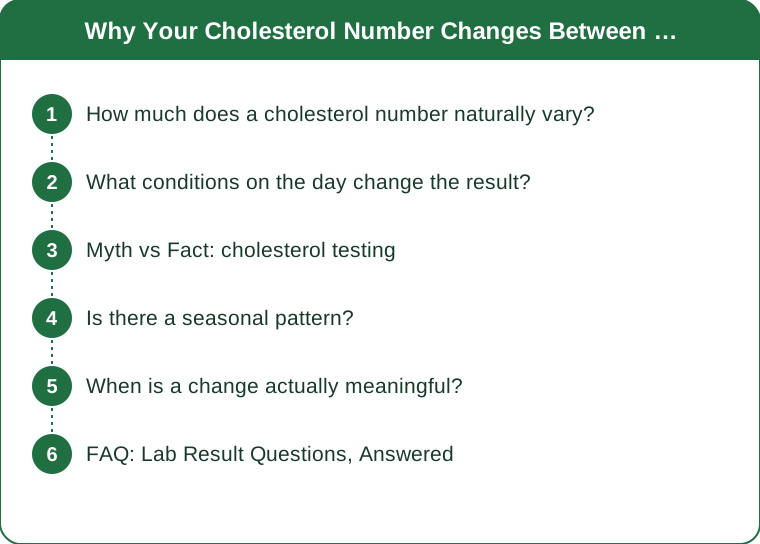
How much does a cholesterol number naturally vary?
More than most people expect. Within the same person, on the same diet, with no changes at all, total cholesterol commonly varies by around 5-10% between measurements. LDL, which is often calculated rather than directly measured, can vary more. Triglycerides are the least stable of the panel and can swing 20% or more.
On a total cholesterol of 200 mg/dL, a 10% swing is 20 points. That is a difference that looks dramatic on a printout and may represent nothing at all.
Two sources stack up here. Biological variation — your actual levels moving day to day — and analytical variation, the measurement error in the lab process itself. Modern labs are tight, but not perfect, and the two add together.
This is general information, not medical advice. Interpretation of your results belongs with your doctor.
What conditions on the day change the result?
Several, and most are avoidable if you know about them:
- Fasting status. Triglycerides rise substantially after a meal, and because LDL is often calculated from triglycerides, a non-fasting draw can shift the LDL figure too.
- Posture. Sitting or lying for several minutes before the draw lowers the reading compared to standing, because plasma volume shifts. The difference can be several percent.
- Tourniquet time. Prolonged tourniquet pressure concentrates the sample and raises the reading.
- Recent illness or infection. Acute inflammation can lower cholesterol temporarily, sometimes markedly, for weeks afterward.
- Recent hard exercise. A very heavy session in the preceding day or two can move triglycerides.
None of these is a lab error. They are all real effects on the sample you gave that morning.
Myth vs Fact: cholesterol testing
Myth: A higher number means my last few days of eating were bad. Fact: Dietary effects on blood cholesterol take weeks to show, not days. What you ate on Tuesday mostly affects triglycerides, not LDL.
Myth: Fasting is always required now. Fact: Many guidelines accept non-fasting lipid panels for routine screening. But if you are comparing to an older fasting result, match the conditions — otherwise you are comparing two different tests.
Myth: A home test and a lab test are interchangeable. Fact: They use different methods with different error ranges. Track trends within one method, not across them.
Myth: One bad number means starting medication. Fact: Standard practice is generally to confirm a significant change with a repeat test before acting on it, alongside your overall risk picture.

Is there a seasonal pattern?
There appears to be. Multiple population studies have found total cholesterol running modestly higher in winter than in summer, with the difference typically in the low single-digit percentage range, somewhat larger in women in some datasets.
The likely drivers are the ordinary ones: less activity, different eating, more indoor time, and plasma volume changes with temperature.
The practical consequence is about comparison. A December result and a July result are not a clean before-and-after. If you started a change in the spring and are checking in late summer, some of the improvement you see may be seasonal, and some of a winter increase may be too.
Where possible, compare like with like — same time of year, same fasting status, same lab.
When is a change actually meaningful?
A few practical rules of thumb, to discuss with your doctor rather than act on alone:
- Repeat before you react. For a change that would alter a decision, a confirming test one to three months later is standard.
- Look at the direction across three points, not two. Two data points make a line; three make a trend.
- Standardise the conditions. Same lab, same fasting state, seated for five minutes before the draw, no heavy training the day before, not during or shortly after an illness.
- Weigh it against everything else. A lipid number is one input into a risk picture that includes blood pressure, family history, smoking status, and more.
If a result is dramatically different from your history — not 15 points, but 60 — that is worth a prompt conversation rather than a wait-and-see.
FAQ: Lab Result Questions, Answered
Should I ask for the same lab every time?
Where it is practical, yes. Different labs may use slightly different methods and calibration, which adds variation on top of everything else.
Does a cold or flu really change my cholesterol?
Acute inflammation can lower lipid levels temporarily, and the effect can persist for several weeks after you feel better. Mention any recent illness when your results are being interpreted.
How long should I wait between tests to see a real change from lifestyle?
Generally around three months. Shorter intervals mostly measure the noise rather than the signal.
TL;DR:
- Cholesterol results vary 5-10% between draws from normal biological and analytical variation alone.
- Fasting status, posture, tourniquet time, recent illness, and season all move the number on the day.
- A 10-20 mg/dL change usually needs a repeat before it means anything.
- Standardise conditions and compare three points, not two.
The useful mindset is to treat any single lipid panel as one noisy sample from a range, rather than a precise readout of your arteries. That is not a reason to ignore it — it is a reason to build a trend before you make decisions from it. This is general information, not medical advice; talk to your doctor about your own results.
Keep Reading
This article is for general informational purposes only and is not medical advice. Always consult a qualified health professional for guidance specific to you.