What to Do With Your Wearable Data at a Doctor Appointment - and What to Leave Out
Quick Answer: Bring trends, not readings. A single night of poor sleep score or one high heart rate is noise; a resting heart rate that has climbed 8 beats over three months, or an irregular rhythm notification, is signal. Summarise on one sheet of paper: what changed, when it started, how much it changed by, and what symptom accompanies it. Leave out sleep stage percentages, stress scores, and readiness scores, which have limited clinical validation and consume appointment time. The wearable metrics doctors most consistently find useful are resting heart rate trends, irregular rhythm alerts, blood oxygen drops during sleep, and step count as an activity baseline.
The frustration is mutual. You arrive with 400 days of data feeling well prepared, and it lands as a spreadsheet nobody has time to open.

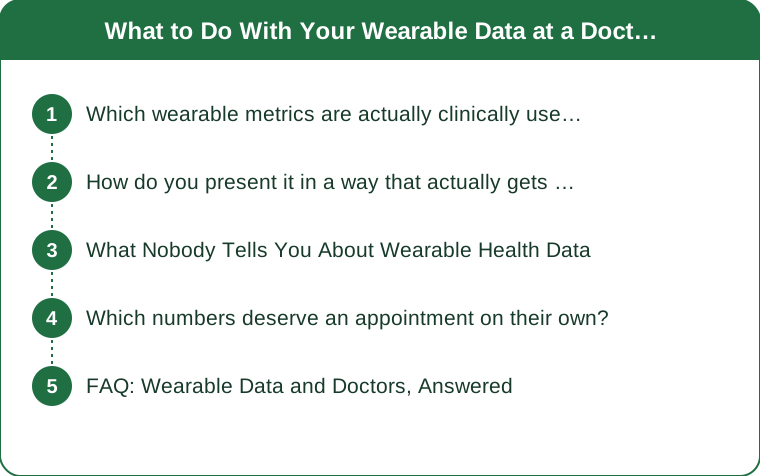
Which wearable metrics are actually clinically useful?
There is a real hierarchy here, and knowing it is the difference between a useful appointment and a wasted one.
Tier 1 - genuinely useful, bring these:
- Resting heart rate trend over months. This is the single most valuable number a consumer wearable produces. It is measured consistently, it has a well-understood physiological basis, and a sustained upward shift can accompany thyroid changes, anaemia, infection, deconditioning, medication effects, or significant stress. A change of 5 to 10 beats sustained over weeks is worth mentioning. One high morning is not.
- Irregular rhythm notifications and single-lead ECG recordings. On devices with regulatory clearance for this, these have real diagnostic weight and are the clearest example of a wearable finding that changes management. Save the recording; do not just describe it.
- Blood oxygen dips during sleep, particularly alongside snoring or daytime sleepiness, can support a conversation about a sleep study. It is a prompt, not a diagnosis.
- Step count as a baseline. Not for its own sake, but because it answers how much do you move accurately, where memory is unreliable.
Tier 2 - context, mention briefly:
- Total sleep duration trend - useful. Sleep stage breakdown - much less so; consumer staging correlates only moderately with lab measurement.
- Heart rate variability trend, if you have many months of it and it has shifted substantially.
Tier 3 - leave it out:
- Stress scores, readiness scores, body battery, sleep scores. These are proprietary composite numbers with no external standard, so they mean nothing to a clinician who cannot see the formula.
- Calorie burn estimates, which are the least accurate output on the device.
- Any single day’s reading, in any category.
The rule that sorts everything: if it is a proprietary score rather than a measured quantity, it does not travel outside the app.
How do you present it in a way that actually gets used?
The constraint is time. A routine appointment gives you roughly ten to fifteen minutes for everything, and data presented poorly consumes it without producing anything.
Use one sheet of paper. Not a phone screen you have to scroll and unlock, not an emailed export. Paper can sit on the desk, be annotated, and go into the notes.
Structure it in four lines:
- What changed. The metric and the direction. Resting heart rate up.
- By how much. From 58 to 67.
- Over what period. Since late June, roughly ten weeks.
- What else you noticed. More tired in the afternoons, cold hands, heavier periods.
That fourth line is what turns data into a clinical question. A number with no symptom is a curiosity; a number with a symptom is a lead. Doctors work from symptoms and use data to support or exclude - presenting it in that order matches how the consultation actually runs.
Screenshot one graph, not twelve. If you show a chart, show the three-month or six-month trend view, where the shape is visible. Daily views show noise and invite the reasonable response that a single reading means little.
Say what you want from it. Ending with a specific question - is this worth a blood test, should I be tracking this differently, is this consistent with the medication I started in June - gives the information somewhere to go. Handing over data without a question puts the burden of working out why you brought it on the other person.
Expect some scepticism, and do not take it personally. Clinicians see a great deal of wearable data that generates anxiety and unnecessary testing. Arriving with a tight, symptom-linked summary rather than a data dump is what distinguishes your version from that.

What Nobody Tells You About Wearable Health Data
Optical heart rate accuracy varies with your wrist, your skin, and the fit. Wrist-based sensors read best when the band is snug and above the wrist bone, and worst during rapid movement, in cold weather when peripheral circulation drops, and on tattooed skin. Resting measurements taken overnight are the most reliable data your device produces, which is exactly why the resting trend outranks everything else.
Sleep staging is the weakest common feature. Consumer devices infer stages from movement and heart rate patterns, and agreement with polysomnography for individual stages is moderate at best. Total sleep time is reasonably good; deep sleep percentage is not a number to make decisions about.
The measurement itself changes behaviour, in both directions. Step counts rise when people watch them - which is a genuine benefit. Sleep scores make some people anxious about sleep, which measurably worsens sleep. There is a recognised pattern of tracker-driven sleep anxiety, and if checking your score is the first thing you do each morning and it colours your day, that is worth saying out loud in the appointment.
Cycle-phase effects will show up in your data and can look alarming. Resting heart rate typically rises by a few beats in the luteal phase, HRV drops, and temperature shifts. Comparing week to week without accounting for cycle phase produces trends that are not trends. If you menstruate, compare the same phase across months.
Your device probably lets you export a summary. Most produce a PDF health report. That is a far better artefact than an app screenshot, and almost nobody knows it exists.
A normal wearable reading does not exclude anything. The reassurance runs one direction only, and using good numbers as a reason not to raise a symptom is the genuinely risky use of this technology.
Which numbers deserve an appointment on their own?
Most wearable findings belong in an appointment you were already having. A few justify making one.
Make an appointment for:
- Repeated irregular rhythm notifications, particularly with palpitations, breathlessness, dizziness, or chest discomfort. This is the clearest case, and the recordings genuinely help.
- A resting heart rate that has risen and stayed risen by roughly 10 beats or more over weeks, without an obvious explanation such as a new medication, illness, or a big drop in training.
- A resting heart rate persistently under about 50 with symptoms - dizziness, fainting, unusual fatigue. Low resting rates are normal and desirable in trained people and mean something different with symptoms attached.
- Repeated overnight oxygen saturation dips alongside loud snoring, witnessed pauses in breathing, or daytime sleepiness.
Go immediately, not to a routine appointment, for chest pain, breathlessness at rest, fainting, or a fast irregular heartbeat with feeling unwell. The device is irrelevant at that point - the symptoms are the reason.
Do not make an appointment for: one bad night, a low readiness score, a week of poor sleep scores during a stressful period, or a step count that dropped while you were on holiday.
The bridge question, if you are unsure: has this persisted for more than two to three weeks, and is it accompanied by anything I can feel? Two yeses is a reason to be seen.
This is general information, not medical advice. If you are worried about a symptom, get it assessed regardless of what your device says.
FAQ: Wearable Data and Doctors, Answered
Will my doctor be annoyed if I bring this?
Some are wary, and it is usually about volume rather than principle. A one-page symptom-linked summary is received very differently from a 40-page export or a phone handed across the desk.
Can wearable data go into my medical record?
A paper summary can be scanned into the notes. Direct integration exists in some systems but is far from universal. Assume it will not sync automatically and bring something physical.
Is a wearable ECG the same as a proper one?
No. Consumer devices record a single lead; a clinical ECG records twelve. A single lead can detect some rhythm abnormalities well and is genuinely useful as a snapshot of an episode you would otherwise never capture, but it does not replace the full test.
My device says my sleep is terrible but I feel fine. Should I worry?
How you feel is the more reliable measurement. Consumer sleep staging is imprecise, and daytime function is what actually matters clinically. If you feel rested and function well, the score is not the thing to fix.
Should I stop tracking if it makes me anxious?
A reasonable middle step is turning off the scores while keeping the passive metrics - the resting heart rate trend still accumulates whether or not you look at it daily. Several people find that reviewing weekly rather than daily removes most of the anxiety and loses none of the useful signal.
TL;DR:
- Bring trends, not readings - and link every number to a symptom and a start date.
- Tier 1 metrics: resting heart rate trend, irregular rhythm alerts and ECGs, overnight oxygen dips, step count baseline.
- Leave out proprietary scores - sleep score, stress, readiness, body battery - and all calorie estimates. No external standard means no clinical meaning.
- One sheet of paper, four lines: what changed, by how much, since when, and what you also noticed. Finish with a specific question.
- Adjust for cycle phase before believing a trend, and remember a normal reading never excludes a symptom.
The device is best at one thing: noticing slow change you would not have felt. Use it for that, and leave the daily scores in the app.
Keep Reading
This article is for general informational purposes only and is not medical advice. Always consult a qualified health professional for guidance specific to you.