What to Do When Your Doctor Says Everything Looks Normal but You Do Not Feel Normal
Quick Answer: Normal on a lab report means within a reference range built from a population, not optimal for you - and a standard panel only tests what was ordered. Reasonable next steps are to get the actual numbers rather than the word normal, ask specifically which tests were and were not run, track symptoms against a timeline, and ask what would change the plan if the symptoms persist. Those four steps move most conversations forward.
Being told everything is fine when you do not feel fine is disorienting. It usually means the tests that were run did not find anything - which is genuinely different from nothing being there.
This is general information rather than medical advice, and it is about how to have a more useful conversation with your doctor, not a substitute for one.

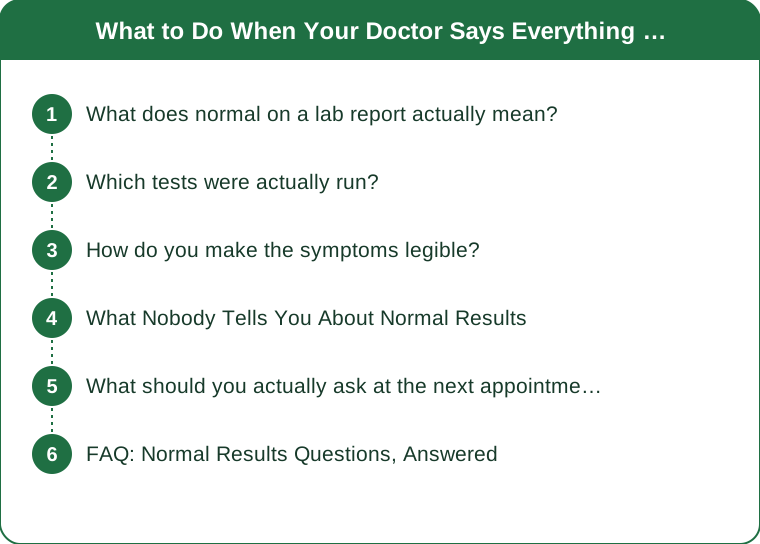
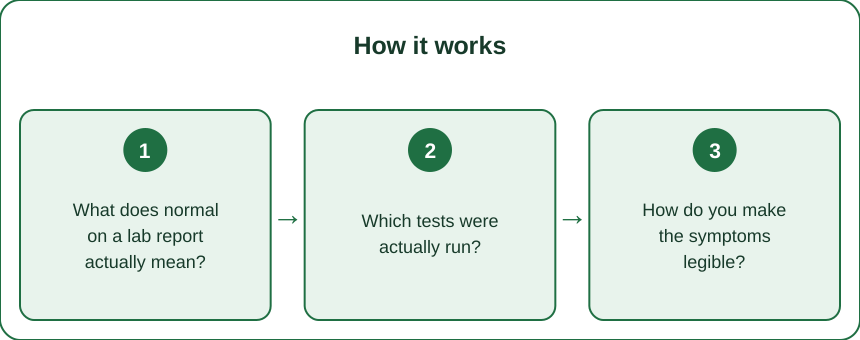
What does normal on a lab report actually mean?
It means your result falls inside a reference range, and reference ranges are statistical, not personal.
How reference ranges are built. For most tests, a range is derived from a reference population, typically capturing the central 95% of results. That means around one in twenty healthy people fall outside the range for any given test, and equally, results at the edge of the range are inside it by definition.
Three consequences worth understanding:
- Ranges vary between laboratories. The same result can be flagged at one lab and not another, because the reference population and the assay differ
- A result at the bottom edge of normal is treated identically to one in the middle. For some markers, the difference between those two positions is clinically meaningful and the flag does not capture it
- Your personal baseline is invisible. If your usual value sits high in the range and has dropped to the low end, that is a substantial change in you - and it will read as normal both times
Which is why the single most useful thing to do is get the numbers. Not the word normal - the actual values, with the units and the reference range. In many systems you can access these through a patient portal or by asking for a printed copy. You are generally entitled to your own results.
Once you have them, they become a baseline. Next year’s results compared against this year’s tell you something that neither year alone can. This is the single highest-value habit in this whole subject, and it costs one request.
Which tests were actually run?
Usually fewer than people assume, and the gap is where a lot of unexplained symptoms sit.
A standard annual panel commonly includes a full blood count, basic metabolic or kidney markers, liver markers, and a lipid panel. That is a reasonable general screen. It is also a fairly narrow one.
Commonly not included unless specifically requested or indicated:
- Thyroid function. Often only TSH, and sometimes not at all. Thyroid dysfunction is common, produces fatigue and a long list of vague symptoms, and is frequently the answer
- Ferritin, which measures iron stores. Haemoglobin can be normal while ferritin is low, and low ferritin alone can cause fatigue, hair shedding, and breathlessness. This is one of the most common gaps in women specifically
- Vitamin D, which is not routinely tested in many places
- Vitamin B12 and folate
- Inflammatory markers such as CRP
- HbA1c, if only a fasting glucose was run
- Coeliac screening, which is under-tested relative to how often it explains chronic fatigue and gut symptoms
The question to ask, phrased usefully: which of these were included, and is there a reason not to check the ones that were not? That is a collaborative question rather than a challenging one, and it usually gets a direct answer.
A caution worth stating. More testing is not automatically better. Every test has a false positive rate, and a broad unfocused panel produces incidental findings that generate anxiety and further investigation for no benefit. The useful version is targeted testing based on your actual symptoms, which is why the symptom timeline in the next section matters so much.
How do you make the symptoms legible?
Write them down as a timeline with specifics. This changes the conversation more than any single test request.
Why it works. A ten-minute appointment gives you very little time to convey a pattern that has developed over months, and under pressure most people describe the symptom they had this morning rather than the shape of the whole thing. A written timeline compresses months into something a doctor can read in thirty seconds.
What to record, for four to six weeks if you have time:
- When it started, as precisely as you can. A specific month is much more useful than a while ago
- The pattern. Constant, or worse at certain times of day, certain days of the week, certain points in your cycle, after certain foods
- Severity on a simple scale, tracked daily. Numbers reveal patterns that memory does not
- What makes it better or worse
- What else changed around the start. New medication, a house move, a job change, an illness, a new supplement. Timing coincidences are genuinely informative and are frequently the thing that unlocks a diagnosis
- The impact. What you have stopped doing because of it. This communicates severity far more effectively than an adjective
Bring one page, not twelve. A single side of A4 with dates and a pattern is enormously helpful. A detailed daily journal is difficult to use in a short appointment.
On menstrual cycles specifically: if you menstruate, tracking symptoms against your cycle is one of the most informative things you can do, and many symptom patterns with a cyclical component get missed entirely because nobody plotted them against a cycle.

What Nobody Tells You About Normal Results
Five things that would save a lot of frustration if they were said out loud.
Normal means the tests did not find it, not that nothing is there. Many conditions have no single diagnostic blood test - migraine, most gut disorders, chronic fatigue conditions, perimenopause, sleep apnoea, and a long list of others are diagnosed clinically. A normal panel does not rule those out, and it was never designed to.
Timing affects results substantially. Iron, thyroid markers, cortisol, and glucose all vary with time of day, recent food, recent illness, and recent exercise. A test taken at 4pm after a hard workout can read differently from the same test at 8am fasted. If a result is borderline, when it was taken is worth knowing.
A recent illness distorts a panel for weeks. Inflammatory markers and iron studies in particular are unreliable in the month after any infection. If you were tested shortly after being unwell, a repeat later is reasonable.
Perimenopause is enormously underdiagnosed and largely invisible on blood tests. Hormone levels fluctuate so much through perimenopause that a single measurement is often uninformative, which is why it is diagnosed on symptoms and age rather than on bloods. Fatigue, sleep disruption, mood change, joint aches, and brain fog in the 40s frequently get tested extensively and explained by nobody.
And the one that matters most: you are allowed to go back. The most common failure mode is not a wrong diagnosis - it is a person who was told everything looked fine, felt dismissed, and never returned. A symptom that persists for another three months is new information, and bringing it back is the normal and expected process, not a nuisance.
What should you actually ask at the next appointment?
Five questions, and they work better than asking for specific tests by name.
1. Can I have a copy of the actual results with the reference ranges? Straightforward, and it gives you a baseline for every future comparison.
2. Which tests were included, and which were not? This surfaces the gaps without requiring you to know what to ask for.
3. Given these symptoms, what are the top few things you are considering, and what have we ruled out? This is the single most useful question in the list. It converts a normal into a reasoning process you can follow, and it usually reveals whether the symptoms have been properly considered or briefly acknowledged.
4. What would need to happen for us to look further? This establishes a threshold. Rather than leaving with nothing, you leave knowing what change or duration would trigger the next step.
5. If this does not improve in X weeks, what is the plan? Books the next step in advance rather than restarting from zero.
Practical things that make appointments more productive:
- Lead with the impact, not the symptom. I have stopped cycling to work because I cannot manage the hill is more informative than I am tired
- State the two most important things first. Appointments run short and the thing mentioned at the end often gets no time
- Ask for a longer appointment when booking if you have several things. Many practices allow it and almost nobody asks
- Take someone with you if you find appointments difficult, or write the answers down
On second opinions. Asking for one is a normal part of medicine and not an insult. If symptoms are significant and persistent and you feel the conversation has stalled, requesting a review with another clinician or asking about a referral is entirely reasonable.
And on urgency: none of this applies to symptoms that are severe, sudden, or worsening quickly - chest pain, difficulty breathing, sudden weakness or numbness, severe abdominal pain, unexplained significant weight loss, or bleeding. Those need urgent assessment rather than a symptom diary.
FAQ: Normal Results Questions, Answered
Does normal mean nothing is wrong?
It means the tests that were run did not find an abnormality. Many conditions are diagnosed clinically rather than on bloods, so a normal panel does not rule them out.
Should I ask for more tests?
Targeted tests based on your symptoms, yes. A broad unfocused panel produces incidental findings that create anxiety and further testing without benefit.
Which tests are most commonly missed?
Ferritin, full thyroid function, vitamin D, and B12 are the most frequent gaps in a standard panel, particularly for fatigue.
How long should I wait before going back?
If symptoms persist or worsen, going back is the expected process. Persistence itself is new clinical information, and there is no minimum waiting period for that.
Can I get my own results?
In most systems, yes - through a patient portal or by asking for a printed copy. Keeping them year to year gives you a personal baseline that a single result cannot provide.
TL;DR:
- Normal means inside a population reference range, not optimal for you - about one in twenty healthy people fall outside it
- Get the actual numbers and ranges, not the word normal, and keep them year to year as a baseline
- Ask which tests were run and which were not; ferritin, full thyroid, vitamin D and B12 are the usual gaps
- Bring a one-page symptom timeline with dates, patterns, and what you have stopped doing
- Ask what would need to change for further investigation, and go back if symptoms persist
A normal result answers the question that was asked. If it was not your question, ask a better one at the next appointment.
Keep Reading
This article is for general informational purposes only and is not medical advice. Always consult a qualified health professional for guidance specific to you.