What to Do When the Symptom Disappears Before the Appointment
Quick Answer: Do not cancel. Intermittent symptoms are common and clinically meaningful, and the pattern is often more diagnostic than the symptom itself. Bring a written timeline with dates, duration, triggers, and severity, plus any photos you took, and open the appointment by saying that it is not happening right now but here is the record. That sentence changes the whole conversation.
It is a strange, slightly embarrassing feeling. You booked because something was clearly wrong, you waited, and now you are sitting in a waiting room feeling like a fraud because today it is not doing it. That feeling causes a lot of people to cancel or to undersell what has been happening, and both are mistakes.

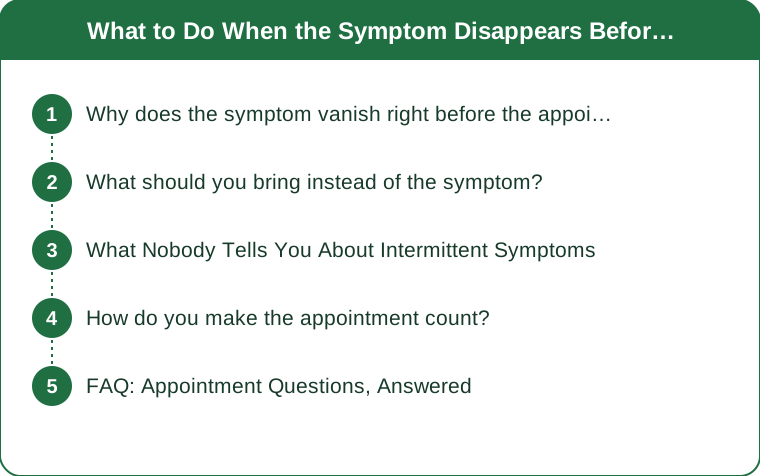
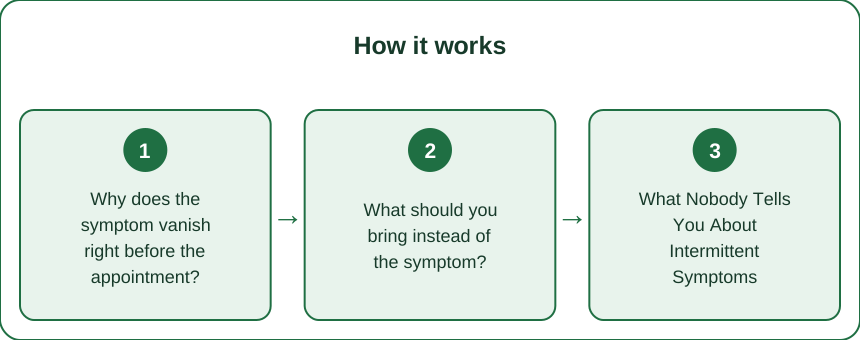
Why does the symptom vanish right before the appointment?
Usually not for any mysterious reason, and understanding which one applies to you helps you describe it accurately.
Most symptoms are episodic by nature. Migraines, palpitations, joint pain, digestive symptoms, dizziness, and skin conditions all come and go. Booking happens during a bad phase, because that is when you are motivated to book, and the appointment lands weeks later, which is often long enough for the phase to pass. This is the single most common explanation and it is not a coincidence - it is a scheduling artefact.
Some things genuinely self-resolve. A large proportion of minor complaints improve on their own within a few weeks, which is a legitimate outcome rather than a false alarm.
Some are trigger-linked. If it is caused by something in your environment, your diet, your workload, or your cycle, it will follow that trigger rather than the calendar. A symptom that has disappeared may simply mean the trigger has.
And a few are situational. Symptoms tied to specific circumstances - a particular activity, position, time of day, or level of stress - are absent in a quiet waiting room by definition.
What none of these mean is that nothing happened. A pattern of episodes is itself clinical information, and in several conditions the pattern is more useful for diagnosis than examining the episode would be.
What should you bring instead of the symptom?
A written record. This is the difference between a five-minute appointment that goes nowhere and one that produces an actual next step.
The timeline. For each episode: the date, roughly how long it lasted, what you were doing before it started, how bad it was on a scale of one to ten, and what made it better or worse. Even four entries is dramatically more useful than a verbal now and then.
The pattern notes. Does it happen at a particular time of day? A particular day of the week? Around your cycle? After specific foods, activities, or poor sleep? Is it getting more frequent, less frequent, or the same?
Photos and recordings. For anything visible - a rash, swelling, discolouration, a change in an existing mark - photos taken during an episode are extremely valuable and there is no substitute for them. Same for a video of a movement problem or a recording of a sound like a cough or wheeze.
Measurements if you have them. Blood pressure readings, resting heart rate, temperature, weight changes, or step-count drops. Anything with a number and a date.
The medication and supplement list, including anything you started or stopped in the months before symptoms began. This gets forgotten constantly and it explains a meaningful fraction of new symptoms.
And your actual question, written at the top. Not I have been feeling off. Something like: this has happened six times in eight weeks, always in the evening, and I want to know whether it needs investigating. Ten minutes is short, and a clear question is what makes short work.

What Nobody Tells You About Intermittent Symptoms
Doctors expect this. The symptom-free appointment is completely routine from the other side of the desk, and no clinician is surprised or annoyed by it. The apologetic opening that many patients lead with is unnecessary and it actively undersells the problem.
How you describe severity matters more than you think. Saying it was not that bad when it was, in fact, bad enough that you sat down on the floor, changes the clinical picture. Describe what you could not do rather than how much it hurt - could not finish the walk, had to leave work, could not sleep. Functional impact is far more informative than a number.
Downplaying is more common than exaggerating. People routinely minimise symptoms in front of a doctor, particularly when they are not currently experiencing them. If you wrote three weeks ago that it was an eight, say eight, not it was quite bad.
Asking what would make this worth coming back for is one of the most valuable questions available. It gives you a specific threshold rather than a vague sense of whether to bother, which is what stops people returning when they should.
And ask for it to be documented. Even if no investigation is warranted today, having the episodes recorded in your notes means that if it recurs in six months, there is a history rather than a fresh start. This is the single most useful thing a symptom-free appointment can produce, and you usually have to ask for it explicitly.
How do you make the appointment count?
Six practical moves, roughly in order.
Open with the framing. Something like: it is not happening today, but it has happened six times since June, and I have written down the dates. This takes eight seconds and it reframes the visit from a wasted slot to a pattern review.
Lead with the most concerning item. Appointments run out of time, and whatever you save for the end may not get discussed. If there are three things, say so at the start so the time can be allocated.
Answer the questions precisely. How long, how often, what makes it worse, what makes it better. Your written timeline means you can answer these accurately instead of estimating, which is exactly why the timeline is worth the effort.
Ask what the possibilities are and what would distinguish between them. This is a better question than what do you think it is, because it tells you what evidence would be useful to gather next time.
Ask for the safety net explicitly. What symptoms mean I should come back sooner, or go to urgent care? Write the answer down in the room.
And ask whether it is worth keeping a diary and what to record. Often the outcome of a symptom-free appointment is a structured period of tracking, and knowing exactly which variables to record makes the next appointment substantially more productive.
Do not cancel because you feel better - and if you must reschedule, ask for the notes to record the reason. This is general information, not medical advice.
FAQ: Appointment Questions, Answered
Should I cancel a doctor appointment if my symptoms went away?
Generally no. Episodic symptoms are common and the pattern itself is clinically useful. At minimum, the episodes get documented, which matters if they return.
How do you explain a symptom that is not happening right now?
With a written timeline: dates, duration, triggers, severity, and what you could not do during each episode. Photos or videos taken during an episode are especially valuable.
What should I write down before a doctor visit?
The episode timeline, your medication and supplement list including recent changes, any measurements you have, and one clearly worded question at the top of the page.
TL;DR:
- Do not cancel - the pattern of episodes is often more useful than witnessing one.
- Bring dates, duration, triggers, severity, and photos taken during an episode.
- Describe what you could not do, not how much it hurt, and do not downplay it.
- Ask what would make it worth returning, and ask for the episodes to be documented.
A symptom that hides on appointment day is not a wasted visit. It is a visit where the written record does the talking instead.
Keep Reading
This article is for general informational purposes only and is not medical advice. Always consult a qualified health professional for guidance specific to you.