What to Ask When Your Numbers Are Normal but You Feel Off
Quick Answer: A reference range typically covers the middle 95% of a reference population - so normal means statistically common, not necessarily right for you. The useful questions are about trend (how has this value moved across years), position within range (near an edge or in the middle), and what was not tested. Bring your own timeline of symptoms, and ask what would change the answer.
Everything came back normal and you still feel tired, or foggy, or not quite yourself. That is a frustrating place to be, and it is also a place where the quality of your next few questions matters more than the results themselves.

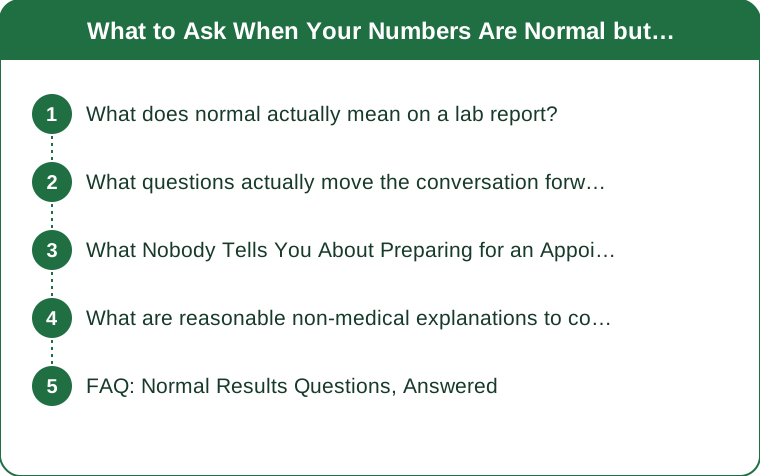
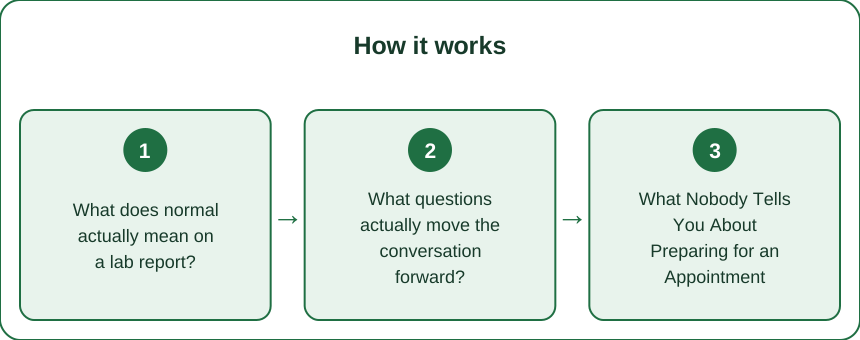
What does normal actually mean on a lab report?
It means your value falls inside a range built from a reference population - usually the central 95% of people who were considered healthy when the range was established.
Three consequences follow, and none of them are obvious from the report.
By construction, about 5% of healthy people fall outside any given range. Run a panel of twenty tests on a completely healthy person and the odds of at least one flagged result are high. A single out-of-range value on a broad panel is often statistical noise rather than a finding.
Ranges are population-based, not personal. If your value has sat near the bottom of a range for a decade and is still near the bottom, that is your normal. If it has moved from the top of the range to the bottom in two years while staying technically inside, the report says normal both times and something real has changed.
Ranges vary by lab. Different analyzers and reference populations produce different cut-offs, so a value flagged at one lab may be unflagged at another. Comparing absolute numbers across labs without checking the ranges is a common source of confusion.
None of this means normal results should be dismissed. It means normal answers the question is this value statistically unusual, and that is a narrower question than are you well.
What questions actually move the conversation forward?
Six, and they are more productive than asking for more tests.
1. How has this value trended over the last few years? The single most useful question available to you. Trend carries information that a single point cannot, and your clinician may have prior results you have never seen plotted together.
2. Where in the range does this sit? Near an edge is different from mid-range, particularly for values where the range is wide.
3. What would you expect to see if my symptoms had a common cause? This reframes the conversation from your results to your experience and often surfaces what has not been tested.
4. What did we not test that could explain this? Standard panels are standard - they are not exhaustive, and the omission is usually about cost-effectiveness at a population level rather than about your case.
5. If this does not improve in six weeks, what is the next step? Getting a written next step prevents the outcome where nothing happens because nothing was clearly abnormal.
6. Is there anything in my history that changes how you read these numbers? Prior conditions, medications, and family history can shift interpretation substantially, and they are easy for a busy appointment to skip.
Write these down beforehand. Appointments are short and recall under pressure is poor.

What Nobody Tells You About Preparing for an Appointment
The quality of the information you bring changes the outcome more than the questions you ask.
A symptom timeline beats a symptom list. Saying you have been tired for a while gives almost nothing to work with. Saying that fatigue started in mid-June, is worst between 2pm and 4pm, is not improved by sleeping longer, and coincided with a change in your work schedule gives a clinician actual structure. Dates, patterns, and what does and does not change it are the details that generate hypotheses.
Two weeks of crude tracking is worth more than months of vague memory. Sleep hours, energy on a 1-10 scale, and anything notable. Not an elaborate log - a line a day. People systematically misremember both the severity and the pattern of symptoms, and a two-week record corrects that.
Bring your own prior results if you have changed providers. Trend is the highest-value question you can ask, and it is unanswerable if the records are scattered across three systems. Requesting your own records is your right and it is usually straightforward.
Lead with your top concern, not chronologically. Appointments compress toward the end, and the thing you mention last frequently gets the least attention. Say the most important thing in the first minute.
Ask for the actual numbers, not just normal. A result described as fine is not something you can track next year. Get the values and the ranges. This is general information, not medical advice - but having your own copy of your own numbers is uncontroversially useful.
What are reasonable non-medical explanations to consider first?
Several common ones account for a lot of feeling-off with normal labs, and they are worth examining honestly before escalating.
Sleep quality rather than quantity. Eight hours of fragmented sleep produces daytime symptoms that look like a lot of other things. Consider whether you wake during the night, whether you feel unrefreshed, and whether anyone has mentioned snoring or pauses in breathing - that last one is worth raising with a clinician specifically.
Seasonal light change. From late August onward, daylight is dropping by 2-3 minutes per day. Reduced morning light exposure shifts circadian timing and affects energy and mood in ways people usually attribute to something else entirely.
A real drop in movement volume. Activity often falls in late summer and autumn without anyone noticing, and lower activity produces fatigue rather than preventing it. Compare your typical daily steps now against three months ago if you have the data.
Under-eating relative to activity, or erratic timing. Persistent low energy with normal labs sometimes comes down to inadequate total intake, insufficient protein, or long gaps between meals.
Cumulative stress load. Chronic stress produces fatigue, cognitive fog, and disrupted sleep, all with normal routine bloodwork.
None of these are reasons to dismiss what you are feeling, and none of them rule out something medical. They are simply the explanations that are both common and addressable, which makes them a sensible place to look while you pursue the rest.
FAQ: Normal Results Questions, Answered
Should I ask for more tests?
Sometimes, but a better opening is to ask which test would change the plan. Tests that would not alter management have a real cost - false positives lead to more testing, anxiety, and occasionally to procedures. A clinician who explains why a test would not change anything is giving you useful information rather than dismissing you.
Is it reasonable to get a second opinion when everything is normal?
Yes, particularly if symptoms are persistent, worsening, or affecting your daily function, and especially if you feel the conversation ended rather than concluded. Bring your records and your timeline so the second opinion starts from data rather than from scratch. Wanting to be taken seriously is a legitimate reason.
How often should routine checks actually happen?
It depends heavily on age, history, and risk factors, and recommendations differ between guidelines - so the honest answer is that this is a conversation to have with your own clinician rather than a number to apply generally. What is broadly useful is keeping your own copies so that whenever testing does happen, the trend is available. This is general information, not medical advice.
TL;DR:
- Normal means inside the central 95% of a reference population - statistically common, not necessarily optimal for you.
- Ask about trend, position within range, and what was not tested rather than simply asking for more tests.
- Bring a dated symptom timeline and two weeks of crude tracking; lead with your top concern in the first minute.
- Consider sleep quality, seasonal light change, dropped activity, intake, and stress load alongside the medical workup.
A normal panel is genuinely good news about a specific set of questions, and it is not an answer to how you feel. The gap between those two things is where better questions live - and walking in with dates, trends, and your own copies of your numbers changes that conversation more than anything else you can do. This is general information, not medical advice.
Keep Reading
This article is for general informational purposes only and is not medical advice. Always consult a qualified health professional for guidance specific to you.