What Your Resting Heart Rate Actually Says About Your Health (And When to Worry)
Quick Answer: A normal resting heart rate for most adults falls between 60 and 100 beats per minute, with well-conditioned individuals often lower; a persistent number outside that range, especially with symptoms like dizziness or fatigue, is worth bringing to a doctor rather than tracking silently.
Your smartwatch shows you a resting heart rate number every morning, but most people have no real sense of what counts as normal, good, or worth mentioning at their next appointment.

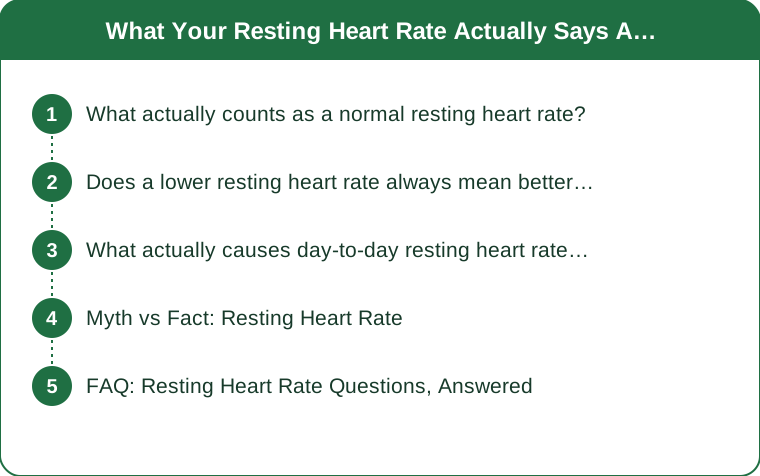
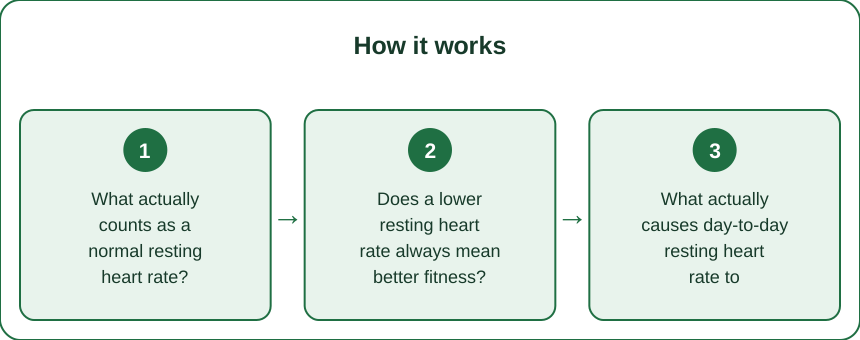
What actually counts as a normal resting heart rate?
The general adult reference range is 60 to 100 beats per minute, measured while genuinely at rest — not right after waking with anxiety about an alarm, but during a calm, still moment. Athletes and highly conditioned individuals often sit lower, sometimes in the 40s to 50s, which reflects cardiovascular efficiency rather than a problem.
Does a lower resting heart rate always mean better fitness?
Generally yes within the normal-to-low range, since a more efficient heart pumps more blood per beat and doesn’t need to beat as often — but a very low number paired with dizziness, fatigue, or fainting is a different situation and should be evaluated rather than assumed to be a fitness marker.

What actually causes day-to-day resting heart rate to fluctuate?
Sleep quality, hydration, stress, illness, caffeine, and even room temperature all shift resting heart rate by several beats per minute day to day — a single day’s number that’s slightly off from your usual baseline is rarely meaningful on its own. A sustained shift over a week or more is a more reliable signal than any single reading.
Myth vs Fact: Resting Heart Rate
Myth: Any number outside 60-100 always signals a problem. Fact: trained athletes routinely sit below 60 with no issue — context and symptoms matter more than the raw number alone.
Myth: Resting heart rate should be measured right when you wake up, still in bed startled by an alarm. Fact: a genuinely calm, several-minutes-still measurement gives a more accurate baseline than the jolt-awake number most smartwatches capture.
Myth: A single day’s unusual reading is cause for concern. Fact: sustained changes over a week or more are the more meaningful signal — one-off fluctuations are usually just noise from sleep, stress, or caffeine.
FAQ: Resting Heart Rate Questions, Answered
What resting heart rate change is significant enough to mention to a doctor?
A sustained shift of 15-20+ beats per minute from your normal baseline, held over more than a few days, especially alongside symptoms like dizziness or unusual fatigue, is worth mentioning at your next visit.
Can stress alone meaningfully raise resting heart rate?
Yes — chronic stress can elevate resting heart rate by several beats per minute through sustained low-level activation of the body’s stress response, independent of any cardiovascular issue.
Is it worth tracking resting heart rate daily, or is that overkill?
Tracking weekly averages rather than obsessing over daily numbers gives a more useful, less noisy picture of genuine trends over time. This is general information, not medical advice — discuss any specific concerns with a doctor.
TL;DR:
- Normal resting heart rate is generally 60-100 bpm; well-conditioned individuals often run lower
- Day-to-day fluctuation from sleep, stress, or caffeine is normal and usually not meaningful alone
- A sustained shift over a week or more, especially with symptoms, is the signal worth acting on
- Track weekly trends rather than obsessing over single daily readings
Check your smartwatch’s weekly average next time instead of today’s single number — it tells you far more.
Keep Reading
This article is for general informational purposes only and is not medical advice. Always consult a qualified health professional for guidance specific to you.