7 Questions to Ask Before Starting Any New Medication (That Most People Skip)
Quick Answer: Before starting any new medication, ask about interactions with what you’re already taking, expected timeline for effect, what side effects warrant a call versus waiting it out, and what happens if you miss a dose. These 7 questions take under 5 minutes and prevent most of the confusion that leads to stopping a medication incorrectly or too early.
A new prescription gets handed over with maybe 90 seconds of explanation before you’re out the door, label barely skimmed. Here are the 7 questions worth actually asking - to your doctor, your pharmacist, or both.

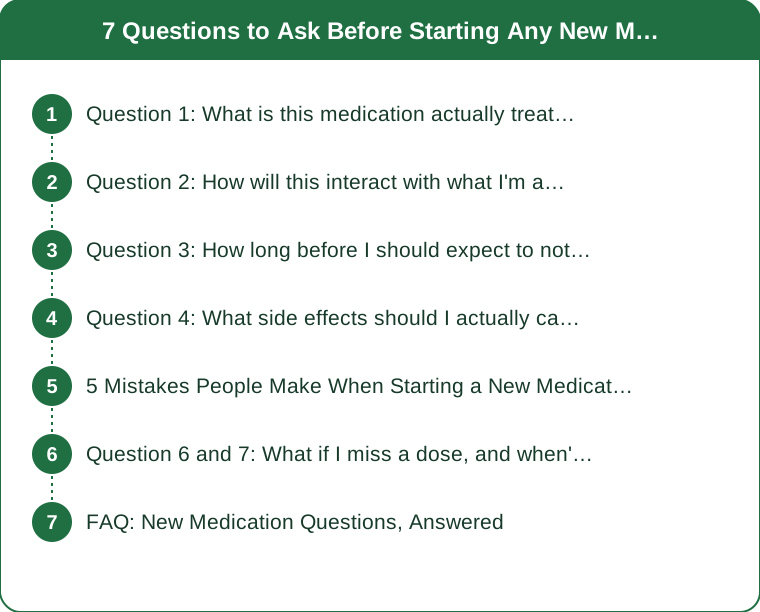
Question 1: What is this medication actually treating, specifically?
This sounds obvious, but many patients leave an appointment with a prescription and only a vague sense of what it’s for - especially when a medication is prescribed for a secondary or less common use than its primary purpose. Getting a clear, specific answer helps you recognize whether it’s working as intended and gives you the actual information needed to research it responsibly afterward if you want to.
This also matters for tracking effectiveness over time - if you don’t know the specific target (a symptom, a lab value, a condition marker), it’s harder to notice and report back on whether the medication is actually doing its job.
Question 2: How will this interact with what I’m already taking - including supplements?
Pharmacists are specifically trained to catch interactions and have access to your full medication history in ways a rushed doctor’s appointment sometimes doesn’t fully cover - this is genuinely one of the most valuable, underused resources available for free at any pharmacy counter. Mentioning supplements and over-the-counter medications specifically matters, since these are commonly left out of the conversation even though they can meaningfully interact with prescriptions.
This question is worth asking even if you’ve had the same prescriber for years, since new medications get added to your regimen over time and interaction risk changes with each addition, not just at the moment of a new prescription.
Question 3: How long before I should expect to notice an effect?
Timeline expectations vary enormously by medication type - some show effect within hours, others (many mental health medications, for instance) can take 2-6 weeks before a noticeable change. Not knowing this timeline is one of the most common reasons people stop a medication too early, mistakenly assuming it isn’t working when it simply hasn’t had enough time yet.
Knowing the expected timeline in advance also helps you distinguish between “this needs more time” and “this genuinely isn’t working and warrants a follow-up call” - a distinction that’s much harder to make without a reference point.

Question 4: What side effects should I actually call about versus just monitor?
Not all side effects require the same response, but medication information sheets often list dozens of possible effects without clear guidance on urgency. Asking specifically “which of these would you want me to call about right away, versus just note and mention at my next visit” gets you a clearer, more actionable answer than reading the full insert alone.
This question also opens the door to asking about serious warning signs specific to that medication that might not be obvious from a generic side effect list - allergic reaction signs, for instance, which sometimes need immediate emergency attention rather than a routine call.
5 Mistakes People Make When Starting a New Medication
1. Stopping abruptly because of a mild side effect without checking first. Some medications require gradual tapering rather than abrupt stopping - always ask before discontinuing on your own, since sudden stopping can sometimes cause worse effects than the original side effect.
2. Not asking about food or timing interactions. Some medications need to be taken with food, others on an empty stomach, and some interact with specific foods (grapefruit is a well-known example for several drug classes) - this detail is easy to miss in a rushed explanation.
3. Assuming the pharmacist can’t help beyond filling the prescription. Pharmacists are a genuinely underused resource for medication questions and are typically available without an appointment, unlike your prescribing doctor.
4. Not asking what to do about a missed dose before it actually happens. Missed-dose guidance varies by medication - some are fine to take late, others should be skipped entirely rather than doubled up - and figuring this out in the moment, stressed, is worse than knowing in advance.
5. Not mentioning all other medications, including ones from a different doctor. Coordination gaps between different prescribers are a real and common source of interaction risk - your pharmacist typically has the most complete picture if you use one main pharmacy consistently.
Question 6 and 7: What if I miss a dose, and when’s the follow-up?
“What should I do if I miss a dose?” has a genuinely different answer depending on the medication - some are fine to take a few hours late, others should be skipped entirely until the next scheduled dose rather than doubled up to compensate. Getting this answer before it happens removes a stressful, uncertain moment later.
“When should I follow up, and what would indicate this isn’t the right medication for me?” sets a concrete checkpoint rather than leaving you to guess whether ongoing side effects or unclear progress warrant reaching back out. Having an actual date or symptom threshold in mind makes the decision to call back feel like following a plan rather than second-guessing yourself.
This is general information, not medical advice - always direct specific medication questions to your prescribing doctor or pharmacist rather than general information sources.
FAQ: New Medication Questions, Answered
Is it annoying to the doctor or pharmacist to ask this many questions?
No - both are professionally expected to answer medication questions, and asking upfront is far preferable to confusion or incorrect use later, which typically requires more of their time to sort out anyway.
Should I write these questions down before an appointment?
Yes, this is genuinely one of the most effective habits for a rushed appointment - having questions written down means you’re less likely to forget one under the pressure of a short visit window.
Can my pharmacist actually answer clinical questions, or only doctors?
Pharmacists are highly trained specifically in medication interactions, timing, and side effects, and are often more immediately accessible than a prescribing doctor for these particular questions - they’re a legitimate first stop, not just a doctor’s backup.
TL;DR:
- Ask what the medication targets specifically, and how it interacts with everything else you take, including supplements
- Get a realistic timeline for effect so you don’t stop a working medication too early
- Clarify which side effects need a call versus just monitoring
- Know the missed-dose plan and follow-up checkpoint before you need either
This is general information, not medical advice - bring these 7 questions to your actual doctor or pharmacist rather than relying on general guidance alone.
Keep Reading
This article is for general informational purposes only and is not medical advice. Always consult a qualified health professional for guidance specific to you.