The Borderline Test Result: What 'Slightly Off' Actually Means and What to Ask Next
A test result that comes back clearly normal or clearly abnormal is at least easy to interpret emotionally — it’s the results that land somewhere in between, flagged as ‘borderline’ or ‘slightly elevated,’ that tend to create the most confusion and anxiety, with the least clear guidance on what to actually do about them. Here is what that classification actually means clinically and the specific questions worth asking. This is general information, not medical advice.

Why Borderline Results Create More Confusion Than Clear Ones
The specific reason: the the-reference-ranges-themselves-are-statistical-not-absolute-boundaries (the normal reference range being defined statistically, typically covering the range where most healthy people fall, meaning values just outside it aren’t a hard biological cutoff but a statistical one, per the blood-test-results-reading-guide logic — the the-range-boundary-is-a-statistical-convention-not-a-biological-cliff-edge), the the-a-single-borderline-value-doesnt-indicate-trend-direction (the one isolated borderline reading providing no information about whether that value is rising, falling, or stable over time, which matters clinically far more than the single number itself — the one-reading-alone-cant-show-a-trend), the the-borderline-doesnt-specify-cause (the classification indicating a number falls in a gray zone without indicating why, whereas a clearly abnormal result more often points toward a more specific, actionable follow-up path — the borderline-tells-you-wheres-not-why), the the-different-labs-and-providers-may-set-slightly-different-thresholds (the exact cutoff for ‘borderline’ varying somewhat by lab and by clinical context, adding another layer of apparent inconsistency to an already ambiguous category — the the-threshold-itself-isnt-perfectly-standardized-across-providers), the the-anxiety-fills-the-interpretive-gap-when-guidance-is-vague (the natural tendency to assume the worst-case interpretation when a result doesn’t come with clear next-step guidance, which happens more with ambiguous borderline results than with either clearly normal or clearly abnormal ones — the ambiguity-invites-worst-case-assumption-by-default), and the reframe (the borderline classification as a genuinely ambiguous statistical category requiring more context to interpret, not a category that inherently means something is quietly going wrong).

What the Classification Actually Means Clinically
The clinical reality: the it-often-means-monitor-not-treat-immediately (the most common clinical response to an isolated borderline result being a recommendation to recheck later and monitor trend, rather than immediate treatment, per the health-numbers-every-woman logic — the monitoring-is-often-the-actual-appropriate-response-not-alarm), the the-context-of-other-results-and-symptoms-matters-more-than-the-single-number (the same borderline number meaning something different depending on accompanying symptoms and other test results, since providers interpret values as part of a broader picture rather than in isolation — the the-full-picture-not-the-single-number-drives-real-interpretation), the the-some-borderline-categories-carry-more-clinical-weight-than-others (the significance of a borderline result varying meaningfully by which specific test it is, since some markers have much more established trend-based clinical protocols than others — the not-all-borderline-results-carry-equal-clinical-significance), the the-a-single-abnormal-reading-can-also-reflect-a-temporary-non-representative-state (the recent illness, dehydration, medication timing or stress sometimes producing a temporarily borderline reading unrelated to any ongoing condition — the a-single-readings-timing-and-context-can-fully-explain-it), the the-your-providers-specific-response-plan-is-the-real-answer-not-a-general-rule (the appropriate next step being specific to your individual history and the exact test involved, meaning no general article, including this one, replaces an actual provider’s specific guidance for your result — the your-own-providers-plan-for-your-specific-result-is-what-actually-matters), and the frame (the clinical meaning as usually indicating monitoring rather than urgent treatment, heavily dependent on context and trend rather than the single number, variable in significance by specific test type, and potentially explained by a temporary factor — genuinely more nuanced than a single ambiguous label suggests).
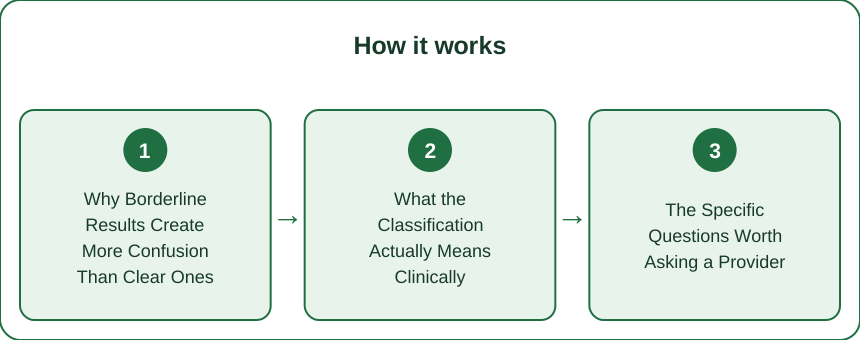
The Specific Questions Worth Asking a Provider
What to actually ask: the what-would-need-to-change-for-this-to-become-a-concern (the asking specifically what direction or magnitude of change in a follow-up test would shift the interpretation, giving a concrete benchmark rather than vague ongoing worry — the ask-for-the-specific-threshold-that-would-actually-matter), the the-when-should-this-be-rechecked-and-why-that-timeframe (the asking for the specific recommended recheck interval and the clinical reasoning behind that particular timeframe, per the how-to-prepare-for-a-specialist-appointment-guide logic — the understanding-the-why-behind-the-timeframe-makes-the-waiting-period-feel-less-arbitrary), the the-is-this-affected-by-anything-i-can-control-in-the-meantime (the asking directly whether diet, medication timing, hydration or other controllable factors plausibly affected this specific result, giving a concrete, actionable focus rather than passive waiting — the ask-for-something-actionable-rather-than-just-waiting-passively), the the-does-this-need-to-be-considered-alongside-any-other-results-i-have (the asking the provider to explicitly connect this result to other recent labs or symptoms, since the full-picture interpretation matters more than any single number — the explicitly-ask-for-the-connected-picture-not-just-the-isolated-number), the the-what-would-you-do-if-this-were-your-own-result (the a direct, human framing of the question sometimes prompting a more genuinely calibrated answer about actual urgency than a more clinical phrasing might — the a-direct-human-framing-can-cut-through-overly-cautious-boilerplate-language), and the frame (the worth-asking questions as what change would matter, why that specific recheck timeframe, what’s actually controllable in the meantime, how this connects to the fuller picture, and a direct human framing of the actual urgency — questions that turn a vague, anxiety-inducing label into a concrete, actionable plan. This is general information, not medical advice.)
Borderline test results create more confusion than clearly normal or clearly abnormal ones because reference ranges are statistical conventions rather than hard biological cutoffs, a single isolated reading provides no information about whether a value is trending up, down or holding steady, and the label itself indicates where a number falls without indicating why — leaving a genuine interpretive gap that anxiety tends to fill with worst-case assumptions. Clinically, an isolated borderline result most often calls for monitoring and a recheck rather than immediate treatment, its real meaning depends heavily on accompanying symptoms and other results rather than the single number in isolation, and it sometimes reflects a temporary, fully explainable factor like recent illness or dehydration rather than an ongoing condition. The most useful questions to bring to a provider are what specific change in a follow-up test would actually shift the interpretation, why that particular recheck timeframe was chosen, whether anything controllable in the meantime plausibly affected the result, how this connects to the broader picture of other labs and symptoms, and a direct human framing like asking what they’d do with this same result themselves. This is general information, not medical advice.
Keep Reading
This article is for general informational purposes only and is not medical advice. Always consult a qualified health professional for guidance specific to you.